← Back to Projects
Thermal Runaway Analysis
Overview
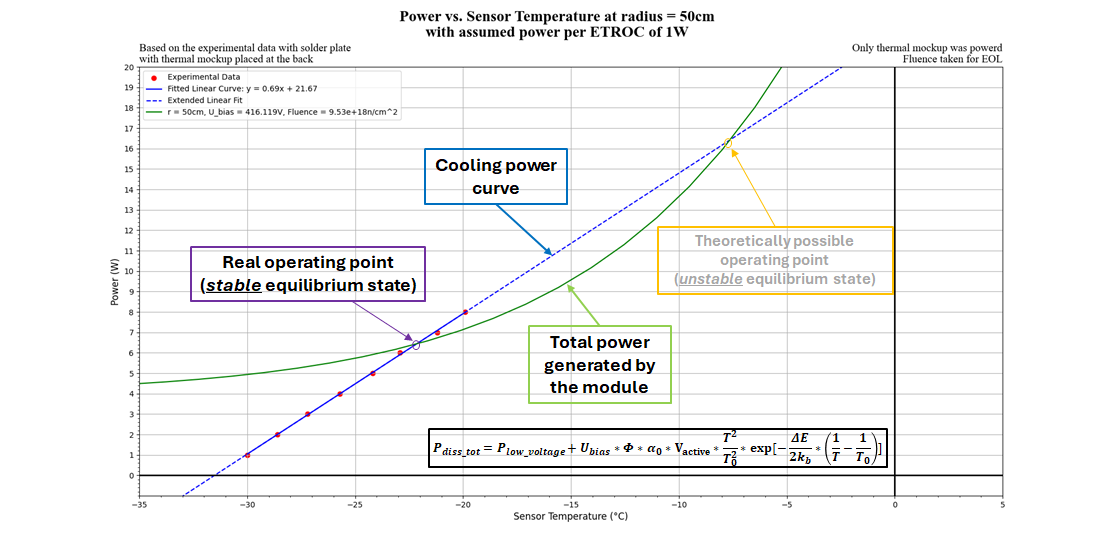
Silicon sensors generate internal leakage current as a result of radiation damage accumulated over the detector's lifetime. This leakage current, dependent on temperature, leads to additional heat dissipation, creating a positive feedback loop in the sensor's temperature that can cause unstable conditions leading to so-called thermal runaway. In the absence of an efficient cooling system, this mechanism continues and the temperature increases exponentially, leading to the shutoff of detector modules.
My Role
- Performed thermal tests with prototype detector modules under all operating conditions to obtain their thermal resistance.
- Modeled the heat dissipation of silicon sensors as a function of temperature, radiation damage, and voltage according to theoretical models available in research papers.
- Combined the experimental data with the theoretical model to predict the operating point of each module over the detector's lifetime, with the aim of obtaining the total expected heat dissipation and comparing it against the detector's overall thermal budget.
Project Gallery
Predicted operating point of a detector module.